



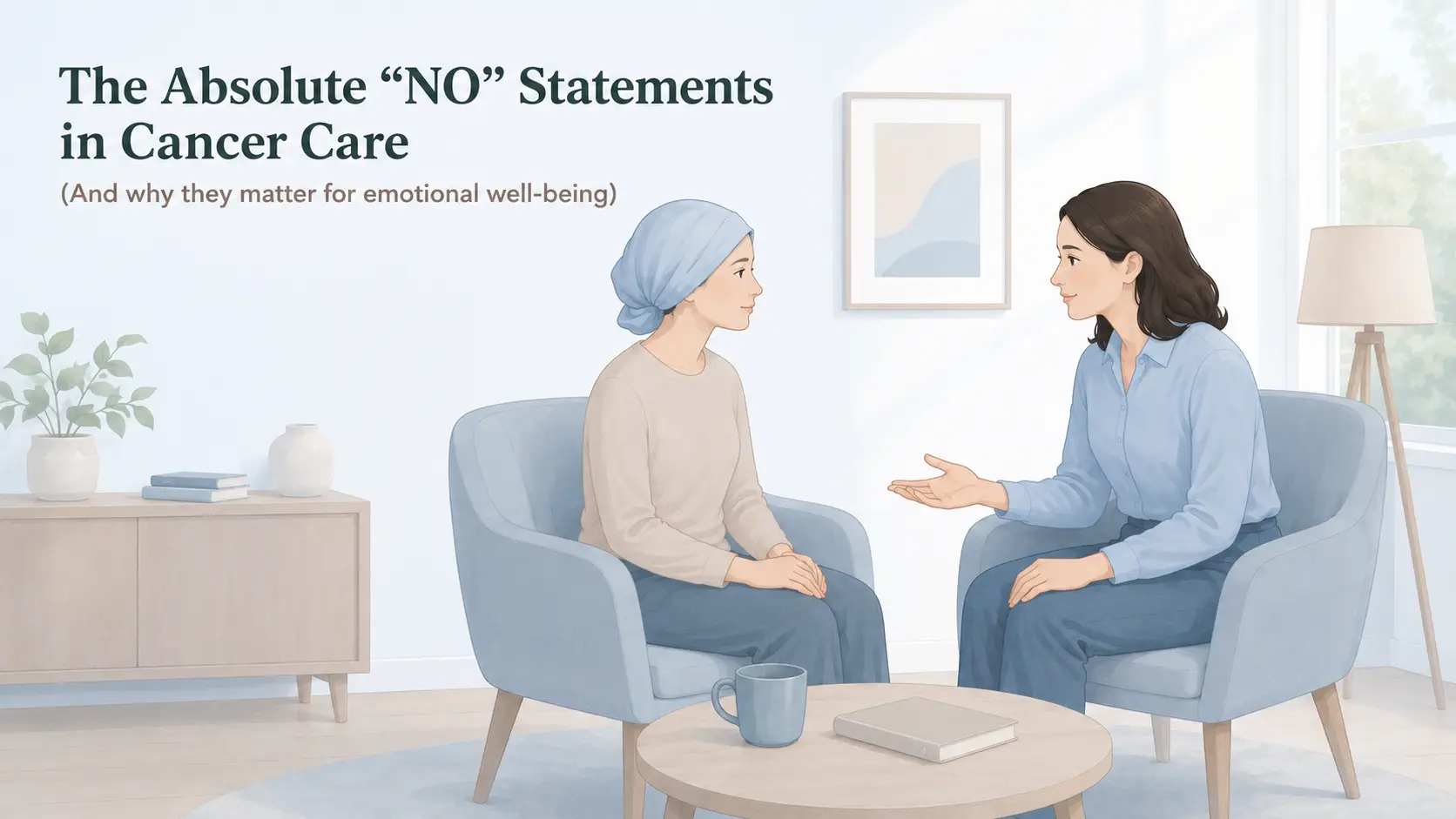
(And why they matter for emotional well-being)
Words can heal-but they can also unintentionally harm.
In psycho-oncology, we often see how well-meaning statements can deepen distress, shame, or isolation for people living with cancer and their families.
Below are some absolute NO statements-phrases that should not appear in clinical care, support conversations, or public messaging-and the emotional reasons they are a “no.”
As you read, you might notice:
“I’ve said this before.”
That’s okay. Awareness is the first step toward compassion.
1. “Stay positive. Your mindset will cure you.”
Why this is a NO:
This places responsibility for the illness on the patient’s emotions, creating guilt, fear, and self-blame when treatment is hard or outcomes are uncertain.
Emotional impact:
- Suppresses normal emotions like fear, sadness, and anger
- Makes patients feel they are “failing” if they struggle
- Increases emotional isolation
Healthier alternative:
“It’s okay to feel however you feel. You don’t have to be positive all the time.”
2. “Everything happens for a reason.”
Why this is a NO:
Cancer is not a lesson, punishment, or cosmic test. This phrase can invalidate pain and feel dismissive of real suffering.
Emotional impact:
- Can provoke anger, shame, or spiritual distress
- Suggests meaning before the person is ready to explore it
- Silences grief
Healthier alternative:
“I’m really sorry this is happening. It’s unfair.”
3. “Others have it worse.”
Why this is a NO:
Pain is not a competition. Comparing suffering invalidates personal experience.
Emotional impact:
- Creates guilt for feeling distressed
- Discourages emotional expression
- Reinforces the belief that one’s pain is “too much”
Healthier alternative:
“What you’re going through is hard, and it matters.”
4. “You’re so strong.”
Why this is sometimes a NO:
While often meant as praise, it can trap people in a role they didn’t choose.
Emotional impact:
- Makes it harder to admit fear or exhaustion
- Encourages emotional masking
- Reinforces the idea that vulnerability is weakness
Healthier alternative:
“You don’t have to be strong here. You’re allowed to rest.”
5. “At least it’s not [a worse cancer / later stage/someone else’s story].”
Why this is a NO:
“At least” statements minimise lived experience, even when the prognosis is good.
Emotional impact:
- Dismisses emotional shock and grief
- Interrupts healthy emotional processing
- Creates confusion: “Why do I feel this bad?”
Healthier alternative:
“Even this is a lot to take in.”
6. “You should be grateful and count your blessings instead of feeling sad, angry, or disappointed.”
Why this is a NO:
Gratitude cannot be forced. Healing requires permission to feel pain first.
Emotional impact:
- Generates shame for normal distress
- Blocks emotional honesty
- Reinforces toxic positivity
Healthier alternative:
“There can be gratitude and grief at the same time.”
7. “Don’t think about it.”
Why this is a NO:
Avoidance increases anxiety. Emotions that are not acknowledged don’t disappear-they
Emotional impact:
- Increases intrusive thoughts
- Encourages emotional suppression
- Delays psychological adjustment
Healthier alternative:
“If you want to talk about it, I’m here.”
8. “You’re lucky it was caught early.”
Why this is a NO:
Even early-stage cancer is traumatic. Diagnosis alone can shatter one’s sense of safety.
Emotional impact:
- Invalidates fear and uncertainty
- Discourages help-seeking
- Creates pressure to “feel fine”
Healthier alternative:
“Even with early detection, this can be overwhelming.”
9. “This will make you stronger.”
Why this is a NO:
Growth cannot be prescribed. Some experiences wound before they strengthen, and some simply hurt.
Emotional impact:
- Imposes meaning prematurely
- Invalidates suffering
- Creates pressure to “transform”
Healthier alternative:
“Right now, surviving is enough.”
10. “You don’t look sick.”
Why this is a NO:
Invisible suffering is still suffering.
Emotional impact:
- Invalidates fatigue, pain, and cognitive changes
- Reinforces stigma around “looking ill”
- Discourages disclosure
Healthier alternative:
“How are you feeling today-really?”
A Gentle Reminder
Mental health struggles during cancer are not a personal failure.
They are human responses to uncertainty, loss, and fear.
In psycho-oncology, we don’t aim to eliminate distress-we aim to make space for it, understand it, and walk alongside it.
If you’re unsure what to say, remember this:
Presence matters more than perfect words.
Want to reflect?
- Which of these statements surprised you?
- Which have you heard-or said-with good intentions?
- What felt validating as you read?
Awareness is compassion in action.
Author: Mrs Rajeshwari A
Senior Psycho-Oncologist