






Home / Knowledge Hub

Recent Blogs

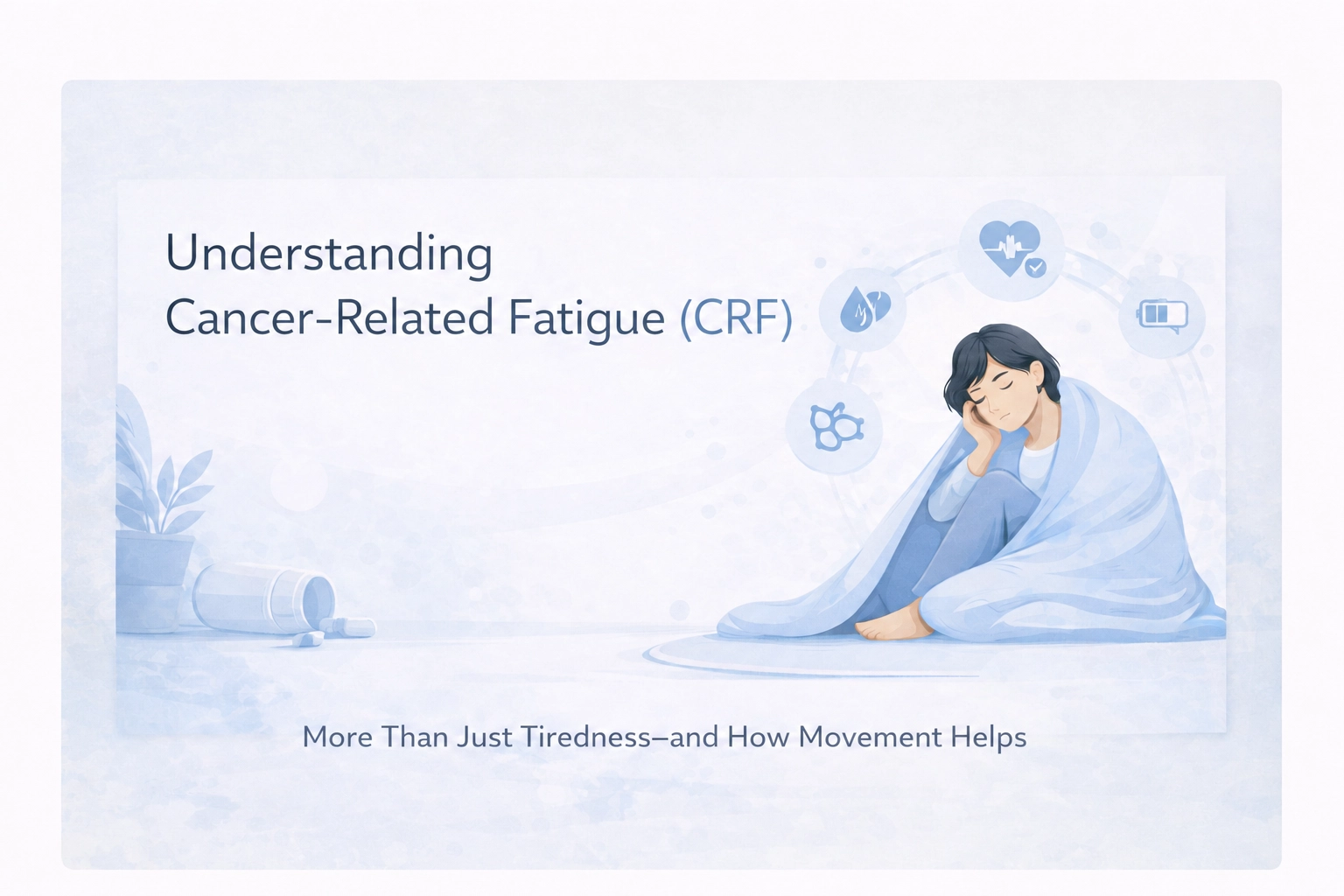
Understanding Cancer-Related Fatigue (CRF): More Than Just Tiredness – And How Movement Helps

After treatment, Kaikai returned home from the hospital completely exhausted. She slept through the night, yet woke up feeling just as drained as before. With ordinary tiredness, rest usually brings relief. This exhaustion, however, did not improve. That was when Kaikai learned about cancer-related fatigue (CRF).

Normal fatigue is the body’s natural signal that rest and recovery are needed. It typically follows physical or mental effort and improves with sleep. Cancer-related fatigue is fundamentally different. It is deep, persistent, often disproportionate to activity, and does not fully resolve with rest or sleep. CRF develops because cancer and its treatments affect multiple body systems at the same time, rather than having a single cause.

Why Cancer-Related Fatigue Feels So Overwhelming

Cancer-related fatigue feels overwhelming because cancer and its treatments affect multiple body systems at the same time. Rather than a single cause, CRF develops from the combined strain placed on the entire body.

Key Body Systems Involved

  • Cellular energy systems
  • Immune system
  • Blood and oxygen transport system
  • Nervous system
  • Hormonal (endocrine) system
  • Lymphatic system
  • Sleep and circadian rhythm system

When several of these systems are stressed simultaneously, the body struggles to restore energy, resulting in deep, persistent fatigue.

Cancer treatments place stress on cells to help destroy cancer. At the same time, this stress can also affect healthy cells-especially the parts responsible for producing energy. When the body’s energy supply is disrupted, muscles feel weak, focus declines, and stamina drops. The result is a deep, whole-body exhaustion that sleep alone cannot relieve.

At the same time, the immune system remains on high alert to protect the body. While this response is necessary, it uses a significant amount of energy. As energy is redirected toward healing and defense, less is available for everyday activities. This can lead to physical discomfort, heaviness, and ongoing fatigue that does not easily improve with rest.

Cancer treatment can also affect the blood’s ability to carry oxygen. When oxygen delivery is reduced, the body must work harder to create energy. As a result, people may experience weakness, shortness of breath, or mental fog. Even small reductions in oxygen supply can significantly worsen fatigue.

The nervous system is often affected as well. Cancer can activate the sympathetic nervous system (the fight-or-flight response) while reducing the activity of the parasympathetic nervous system (the rest-and-repair system). This imbalance can lower levels of key neurotransmitters such as dopamine, serotonin, and GABA, which support motivation, mood, calmness, and sleep. When these systems are out of balance, fatigue is felt not only physically, but mentally and emotionally as well.

Hormonal regulation may also be disrupted. Cancer and its treatments can affect the endocrine system (the body’s hormone-regulating system), leading to lower thyroid hormones, which slow metabolism and reduce energy. Changes in cortisol (the stress hormone) , creating a “tired but wired” feeling. Levels of sex hormones such as estrogen or testosterone may also decrease, affecting motivation and overall vitality. Together, these hormonal shifts can intensify fatigue and interfere with restful sleep.

The lymphatic system, which helps remove waste, toxins, and excess fluid, may also slow due to surgery, radiation, inflammation, or reduced movement. When lymphatic flow is impaired, people may experience swelling, heaviness, pressure sensations, and increased fatigue. Slower waste clearance can leave the body feeling burdened and depleted.

Sleep disruption further compounds fatigue. Sleep is essential for tissue repair, restoration of energy systems, and clearing waste products from the brain. During cancer and its treatment, sleep may be disturbed by pain, anxiety, steroid medications, night sweats, altered stress hormone rhythms, and hospital routines. Without deep, restorative sleep, the body cannot fully recover, allowing fatigue to accumulate over time.Taken together, cancer-related fatigue is not simply “being tired.” It reflects widespread strain across the body-impaired energy production, chronic inflammation, reduced oxygen delivery, nervous system imbalance, hormonal disruption, slowed lymphatic flow, and incomplete recovery during sleep.

When Movement Becomes Medicine

So what can help?

For Kaikai, understanding what was happening inside her body was the first step. Knowing that her exhaustion had real biological roots-not weakness or lack of effort-brought relief. She also learned that gentle movement, when done mindfully and appropriately, could support recovery rather than drain her further.

Research shows that gentle movement-especially yoga and other mindful practices-can support multiple body systems at the same time, making it particularly effective for managing cancer-related fatigue and treatment side effects. Gentle movement improves blood flow and oxygen delivery, helping the body create and use energy more efficiently. Yoga has also been shown to calm inflammation by reducing inflammatory signals such as IL-6, TNF-α, and NF-κB, supporting immune balance and easing fatigue.

Movement-based practices also help activate the parasympathetic nervous system (the body’s rest-and-recovery system), allowing the body to shift out of constant stress mode. Practices such as slow, gentle yoga postures, mindful breathing, and Yoga Nidra calm brain activity and encourage deep physiological rest. Improved sleep quality appears to be a key mechanism by which yoga reduces fatigue. Large clinical studies show that better sleep explains a significant portion of yoga’s fatigue-reducing effects.

Strong clinical evidence supports these benefits. In a Phase III randomized controlled trial involving over 400 cancer survivors, a four-week yoga program significantly reduced cancer-related fatigue compared to standard care (Mustian et al., 2018)https://journals.sagepub.com/doi/10.1177/1534735419855134. Other studies show that yoga can reduce inflammatory gene expression, stabilize inflammation-related markers, lower oxidative stress during treatment, and improve overall quality of life https://www.sciencedirect.com/science/article/pii/S0306453014000444. Meta-analyses consistently find that yoga and mindfulness-based practices have meaningful positive effects on cancer-related fatigue (Kirkwood et al., 2022)Meta-analysis of yoga interventions for cancer-related fatigue (JNCI).

A Compassionate Path Forward

In summary, cancer-related fatigue is a real, complex, whole-body condition arising from the combined effects of cancer and its treatment. While it can feel persistent and overwhelming, evidence shows that gentle movement, along with adequate rest, nutrition, and appropriate medical care, can significantly reduce fatigue and improve quality of life.

For Kaikai, this understanding marked a turning point. Rather than pushing herself to “get back to normal,” she began listening to her body and supporting it with mindful movement, breath, and rest. With yoga as a companion in her recovery, she started rebuilding energy-not by forcing it, but by allowing her body the time and support it needed to heal.

Verify your OTP

Please fill the OTP 

Get Access

Please fill the form to get access

Home / Terms & Conditions

EaseMyCancer Terms & Condition

By enrolling in any program offered by EaseMyCancer, I understand and agree that:

  • Program fees are payable in advance and are generally non-refundable unless otherwise stated in writing.
  • Sessions must be used within the validity period of the selected plan. Missed sessions may not be compensated or carried forward.
  • Participation is voluntary, and I may discontinue the program at any time; however, fees already paid may not be refundable.
  • EaseMyCancer does not guarantee specific health, treatment, or recovery outcomes.
  • All educational materials, recordings, and resources provided by EaseMyCancer are for personal use only and may not be copied, shared, or reproduced without prior written permission.
  • EaseMyCancer and its team shall not be held liable for any injury, loss, or damages arising from participation in the program, except to the extent required by applicable law.
  • These Terms & Conditions are governed by the laws of India, and any disputes shall be subject to the jurisdiction of the courts of Bengaluru.

Home / Consent Form

EaseMyCancer Consent Form

Introduction

At EaseMyCancer, we provide supportive care that nurtures the body, mind, and spirit. This consent form ensures that you are fully informed about our services, your rights, and responsibilities before participation.

1. Purpose of Services

EaseMyCancer offers supportive care services, including:

  • Yoga, mindful movement practices, and emotional well-being support.
  • Nutrition guidance and personalised nutrition plans.
  • Psycho-oncology group sessions and counselling.

These services support your overall health and quality of life. They are not a replacement for medical treatment or preventive in nature, and are meant to complement your medical care.

2. Information Sharing & Confidentiality

  • I consent to share personal, medical, and emotional information only for designing and delivering my personalised support plan.
  • This information may be shared within the EaseMyCancer team (program coordinator, yoga & emotional well-being specialists, nutritionists, psycho-oncologists) solely for my care.
  • My data will be securely stored and not shared outside EaseMyCancer without my consent, except where required by law.

3. Payment & Services

  • Services are chargeable and payment is required in advance.
  • Fees cover planning, delivery, and follow-up.
  • Payments are non-refundable, unless otherwise stated.
  • Missed sessions beyond the agreed schedule will not be compensated or carried forward.

4. Responsibility & Medical Disclaimer

  • I will continue to consult my doctor regarding all treatment decisions.
  • I have informed and taken consent from my consulting doctor regarding the program.
  • I accept full responsibility for my health and will inform my facilitator of any changes.
  • EaseMyCancer does not provide emergency medical services. In an emergency, I will contact my doctor or emergency services.

5. Participation

  • Participation is voluntary.
  • I may withdraw consent at any time by providing written notice; service fees may not be refundable.

6. Recording & Documentation

  • Apart from yoga and emotional well-being sessions, which may be recorded for internal quality review and training purposes, no other session will be recorded by EaseMyCancer without my explicit consent.
  • I agree as a participant not to record any session in any form to maintain privacy of other participants.

Tavleen

Behavioural Insights & User Research Specialist

Specializes in behavioural insights and user research with experience across health & fitness, government, and retail sectors. Focuses on translating human behaviour into strategic insights that inform product and business decisions, contributing to user-centered and data-driven approaches.

Nitin Agarwal

Technology Advisor, EaseMyCancer

Technology leader and entrepreneur with nearly two decades of experience building and scaling large-scale digital platforms. Has held leadership roles across global technology companies including Flipkart, Ola, GoTo Group, Yahoo, and Curefit (Cult.fit), and currently leads product and engineering at Bhanzu. Brings expertise in product engineering, platform scalability, and innovation, supporting EaseMyCancer in building accessible, technology-driven patient care solutions.

Dr. Sai Vivek V

Consultant Medical & Hemato-Oncologist | Advisor, EaseMyCancer

Consultant Medical and Hemato-Oncologist at Aster Hospitals with nearly six years of experience. Expertise includes solid organ and blood cancers in adults and children, precision oncology, immunotherapy, preventive oncology, and integrative cancer care. Academic background includes MBBS, MD in Internal Medicine, and DM in Medical Oncology. Also serves as an Advisor at EaseMyCancer, supporting patient-centered and integrative oncology initiatives.

Dr. Seema Rao

Director & Consultant, Palliative Medicine | Advisor, EaseMyCancer

Director and Consultant in Palliative Medicine at Manipal Hospice and Respite Center, with a background in psychiatry and a Master’s in Palliative Medicine (Distinction) from Cardiff University as a Commonwealth Scholar. Has led major clinical, academic, and research initiatives, including ICU–palliative care integration and national training programs. Focus areas include comprehensive palliative care and psycho-spiritual support. Serves as an Advisor at EaseMyCancer, contributing to integrated and compassionate care systems.

Priya Kataria

Senior Clinical Nutritionist & Therapy Delivery Lead

Leading clinical nutritionist specializing in oncology nutrition, with over a decade of experience supporting more than 10,000 cancer patients. Known for delivering outcome-driven, personalized nutrition strategies that improve treatment tolerance, recovery, and quality of life. Approach is rooted in clinical precision and integrative care, combining detailed assessments with scientifically backed interventions aligned with medical treatment.

Sonal Devji Patel

Onco Yoga Trainer

Certified Yoga Practitioner (MSc Yoga & Vedic Therapy) and Gold Medalist in Yoga, with therapeutic training at Arogyadhama. Currently serves as an Onco Yoga Trainer at EaseMyCancer, delivering personalized yoga and pranayama sessions for individuals affected by cancer. Focus areas include reducing fatigue, improving energy levels, and enhancing emotional well-being to support resilience during treatment.

Rajeshwari A

Senior Psycho-Oncologist

Brings nearly a decade of experience in supporting individuals and families navigating the psychological challenges of cancer. Has supported over 10,000 patients and their families through evidence-based, patient-centered psycho-oncology care, helping strengthen emotional resilience and quality of life. Actively collaborates with multidisciplinary teams and facilitates individual therapy and support groups, creating safe spaces for coping, healing, and meaningful connection.

Hemalatha S N

Program Coordinator & Executive Assistant – Founder’s Office

Brings a strong academic background in Biochemistry along with experience in supporting individuals navigating oncology care. Work focuses on patient coordination, program management, and ensuring seamless communication across teams. Closely collaborates with clinical and operational teams while supporting the Founder’s Office with coordination and day-to-day execution, contributing to a structured and supportive environment that enhances patient experience and organizational efficiency.

Parul Agarwal

Founder, EaseMyCancer

Founder of EaseMyCancer, Certified Cancer Support Specialist (UK), and Certified Yoga Teacher with nearly a decade of experience in healthcare and wellness. Among the first few Indians to complete advanced international specialization in cancer support and integrative oncology care. Designs structured, evidence-informed programs focused on preventive health, stress regulation, emotional resilience, and sustainable wellbeing for individuals and organisations.