







Home / Knowledge Hub

Recent Blogs

Fatty Liver & Breast Cancer

A Quiet Conversation Between Survival, Hormones, and Metabolism

Most women don’t think about their liver when they think about breast cancer.

The breast is clinically visible and routinely evaluated, while the liver, despite its central metabolic roles, works quietly behind the scenes and is often overlooked unless abnormalities surface on investigation.

And yet, in clinics and survivorship programs, a familiar pattern continues to appear.
A woman completes breast cancer treatment.
Her scans are reassuring.
Life slowly begins again.

Then, almost incidentally, a report reads:
“Fatty liver changes noted.”

No alcohol.
No dramatic weight gain.
Often, no symptoms at all.

So how did the liver enter this story?

The answer lies in understanding that breast cancer does not exist in isolation-and neither does the liver.

The Liver: The Metabolic Interpreter of the Body

The liver is not just a detox organ.
It is the body’s metabolic interpreter.

It decides:

  • How hormones are processed
  • How glucose is stored or released
  • How fats are burned or accumulated
  • How inflammation is regulated

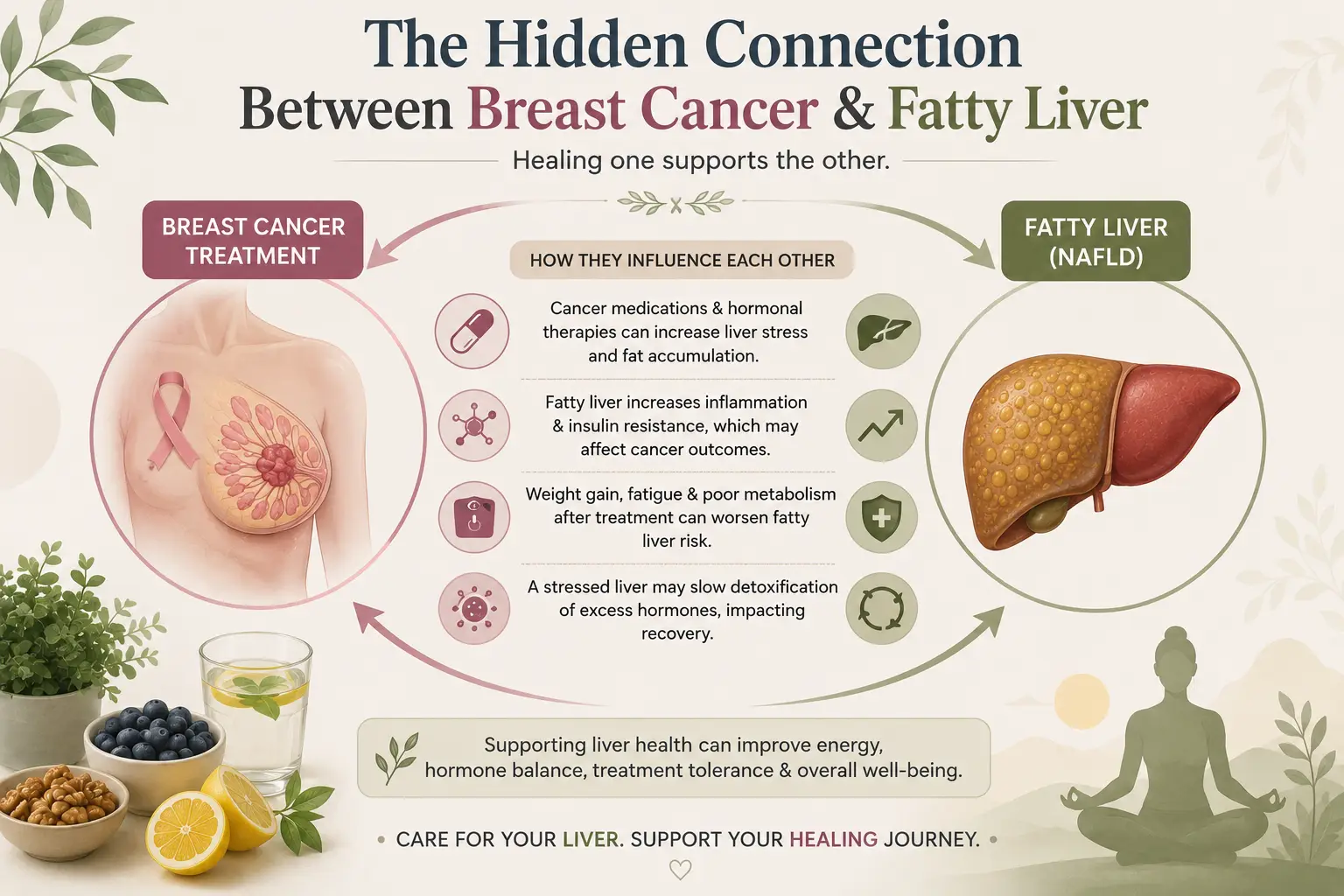
And importantly, it plays a central role in estrogen metabolism-the very hormone that drives most breast cancers. When the liver is metabolically healthy, estrogen is processed efficiently and excess is eliminated. When the liver accumulates fat, this balance quietly shifts.

Fatty Liver: More Than a “Lifestyle Condition”

Non-alcoholic fatty liver disease (NAFLD) affects nearly 1 in 3 adults worldwide. In women, especially after their 30s and 40s, it often develops silently.

A fatty liver is not passive fat storage. It is:

  • Insulin resistant
  • Chronic inflammatory
  • Hormone-disruptive

It releases cytokines, alters lipid signaling, and changes how estrogen circulates in the body. This creates an internal environment that is far more biologically active than it appears on an ultrasound screen.

Where Fatty Liver and Breast Cancer Intersect?

1. Estrogen Handling Goes Off Balance

The liver is responsible for metabolizing estrogen into forms that can be safely excreted.

In fatty liver:

  • Estrogen clearance slows
  • Circulating estrogen levels rise
  • Estrogen metabolites shift toward more pro-inflammatory, proliferative pathways

For estrogen-receptor-positive (ER+) breast tissue, this prolonged exposure matters. Not immediately. But over the years, it increases the background risk for initiation, progression, and recurrence.

2. Insulin Resistance: A Shared Metabolic Language

Fatty liver and breast cancer share a common metabolic driver: Insulin resistance. When the liver becomes insulin-resistant:

  • Fasting insulin in the blood remains chronically elevated
  • Insulin-like growth factor-1 (IGF-1) increases
  • Cellular growth signals stay persistently active

Breast cells exposed to this environment receive repeated messages to grow, divide, and resist apoptosis.

Cancer does not need chaos. It thrives in the consistency of excess signaling.

3. Chronic Inflammation: The Quiet Background Noise

Fatty liver is an inflammatory state, even before it progresses to fibrosis.

The liver releases:

  • TNF-α
  • IL-6
  • C-reactive protein

These inflammatory messengers:

  • Promote DNA damage
  • Impair immune surveillance
  • Support tumor-friendly environments

Breast cancer does not arise overnight. It grows within this slow-burning inflammatory background.

Then Comes Treatment and the Liver Adapts to Survival

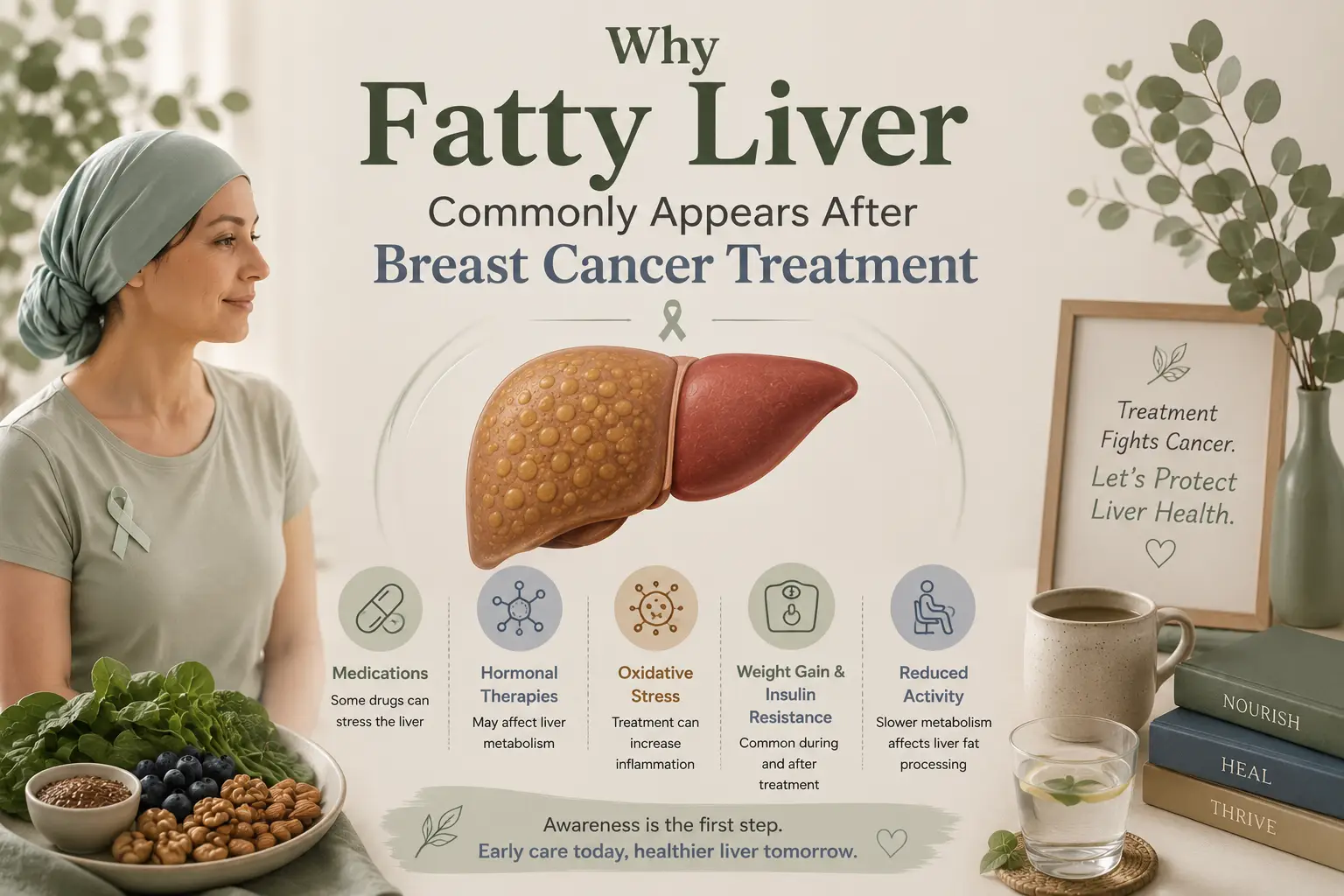
For many women, fatty liver does not precede breast cancer. It follows treatment. This is not a coincidence. It is a physiological response to survival stress.

Why Fatty Liver Commonly Appears After Breast Cancer Treatment
1. Chemotherapy: A Metabolic Shock

Chemotherapy drugs are metabolized primarily by the liver. During treatment:

  • Mitochondrial fat oxidation slows
  • Oxidative stress increases
  • Inflammatory signaling rises
  • Hepatic lipid handling becomes inefficient

Clinical studies have documented chemotherapy-associated hepatic steatosis, even in women who were metabolically healthy before treatment.

The liver adapts by storing fat – not because of excess intake, but because processing pathways are overwhelmed.

2. Steroids: The Underestimated Contributor

Corticosteroids are routinely used during chemotherapy to:

  • Prevent nausea
  • Reduce hypersensitivity reactions
  • Improve drug tolerance

Repeated steroid exposure:

  • Increases insulin resistance
  • Raises blood glucose
  • Promotes visceral and hepatic fat deposition

While essential during treatment, steroids quietly reprogram metabolic pathways in the liver.

3. Hormone Therapy and Estrogen Withdrawal

For many survivors, treatment extends well beyond chemotherapy.

Tamoxifen and aromatase inhibitors, though life-saving, significantly alter estrogen signaling.

Tamoxifen, in particular, has been strongly associated with:

  • Reduced hepatic fatty acid oxidation
  • Altered lipid metabolism
  • Development of fatty liver

Estrogen is protective for the liver. Its sudden withdrawal, whether through medication or treatment-induced menopause – makes the liver more vulnerable to fat accumulation.

4. Muscle Loss: The Missing Link Few Talk About

During cancer treatment:

  • Poor appetite often leads to low protein intake.
  • Physical activity reduces
  • Fatigue limits movement

Even without visible weight change, skeletal muscle mass declines. Muscle is the primary site of glucose disposal.

  • Insulin resistance increases
  • More glucose is diverted toward fat storage
  • The liver becomes a default storage site

This explains why many survivors say:  “I didn’t gain much weight, but I still have fatty liver.”

5. Stress, Sleep, and Cortisol

Cancer is not a short-term stress. It is prolonged uncertainty.

Chronic stress:

  • Elevates cortisol
  • Disrupts circadian metabolism
  • Promotes central and hepatic fat storage

Sleep fragmentation during treatment further impairs liver repair mechanisms.The liver, like the brain, heals best with rhythm.

6. The Gut–Liver Axis After Treatment

Chemotherapy and antibiotics alter gut microbiota.

This leads to:

  • Increased gut permeability
  • Endotoxin leakage into circulation
  • Low-grade liver inflammation

The gut–liver axis becomes a silent driver of post-treatment fatty liver.

Why This Matters in Breast Cancer Survivorship

Fatty liver after breast cancer is not a cosmetic finding. In survivors, NAFLD has been associated with:

  • Persistent fatigue
  • Higher cardiometabolic risk
  • Impaired metabolic recovery
  • Potential impact on long-term outcomes

Survivorship is not just about being cancer-free. It is about restoring metabolic resilience.

The Reassuring Truth: Fatty Liver Is Often Reversible

Post-treatment fatty liver is not a failure of discipline.

It is a biological response to:

  • Treatment stress
  • Hormonal shifts
  • Muscle loss
  • Metabolic adaptation

With proper help of

  • Targeted nutrition 
  • Muscle rebuilding
  • Insulin-sensitizing strategies
  • Gut and liver support
  • Stress and sleep repair

The liver often recovers, sometimes dramatically.

Takeaway:

Breast cancer teaches us to closely monitor what is visible and measurable. Fatty liver reminds us to pay equal attention to metabolic health that often progresses silently.

Because for many women, breast health does not end with the completion of treatment-it continues through the long-term metabolic adaptations that follow survival. Supporting liver health becomes an essential part of recovery, helping the body restore balance after the physiological demands of cancer therapy.

Verify your OTP

Please fill the OTP 

Get Access

Please fill the form to get access

Home / Terms & Conditions

EaseMyCancer Terms & Condition

By enrolling in any program offered by EaseMyCancer, I understand and agree that:

  • Program fees are payable in advance and are generally non-refundable unless otherwise stated in writing.
  • Sessions must be used within the validity period of the selected plan. Missed sessions may not be compensated or carried forward.
  • Participation is voluntary, and I may discontinue the program at any time; however, fees already paid may not be refundable.
  • EaseMyCancer does not guarantee specific health, treatment, or recovery outcomes.
  • All educational materials, recordings, and resources provided by EaseMyCancer are for personal use only and may not be copied, shared, or reproduced without prior written permission.
  • EaseMyCancer and its team shall not be held liable for any injury, loss, or damages arising from participation in the program, except to the extent required by applicable law.
  • These Terms & Conditions are governed by the laws of India, and any disputes shall be subject to the jurisdiction of the courts of Bengaluru.

Home / Consent Form

EaseMyCancer Consent Form

Introduction

At EaseMyCancer, we provide supportive care that nurtures the body, mind, and spirit. This consent form ensures that you are fully informed about our services, your rights, and responsibilities before participation.

1. Purpose of Services

EaseMyCancer offers supportive care services, including:

  • Yoga, mindful movement practices, and emotional well-being support.
  • Nutrition guidance and personalised nutrition plans.
  • Psycho-oncology group sessions and counselling.

These services support your overall health and quality of life. They are not a replacement for medical treatment or preventive in nature, and are meant to complement your medical care.

2. Information Sharing & Confidentiality

  • I consent to share personal, medical, and emotional information only for designing and delivering my personalised support plan.
  • This information may be shared within the EaseMyCancer team (program coordinator, yoga & emotional well-being specialists, nutritionists, psycho-oncologists) solely for my care.
  • My data will be securely stored and not shared outside EaseMyCancer without my consent, except where required by law.

3. Payment & Services

  • Services are chargeable and payment is required in advance.
  • Fees cover planning, delivery, and follow-up.
  • Payments are non-refundable, unless otherwise stated.
  • Missed sessions beyond the agreed schedule will not be compensated or carried forward.

4. Responsibility & Medical Disclaimer

  • I will continue to consult my doctor regarding all treatment decisions.
  • I have informed and taken consent from my consulting doctor regarding the program.
  • I accept full responsibility for my health and will inform my facilitator of any changes.
  • EaseMyCancer does not provide emergency medical services. In an emergency, I will contact my doctor or emergency services.

5. Participation

  • Participation is voluntary.
  • I may withdraw consent at any time by providing written notice; service fees may not be refundable.

6. Recording & Documentation

  • Apart from yoga and emotional well-being sessions, which may be recorded for internal quality review and training purposes, no other session will be recorded by EaseMyCancer without my explicit consent.
  • I agree as a participant not to record any session in any form to maintain privacy of other participants.

Tavleen

Behavioural Insights & User Research Specialist

Specializes in behavioural insights and user research with experience across health & fitness, government, and retail sectors. Focuses on translating human behaviour into strategic insights that inform product and business decisions, contributing to user-centered and data-driven approaches.

Nitin Agarwal

Technology Advisor, EaseMyCancer

Technology leader and entrepreneur with nearly two decades of experience building and scaling large-scale digital platforms. Has held leadership roles across global technology companies including Flipkart, Ola, GoTo Group, Yahoo, and Curefit (Cult.fit), and currently leads product and engineering at Bhanzu. Brings expertise in product engineering, platform scalability, and innovation, supporting EaseMyCancer in building accessible, technology-driven patient care solutions.

Dr. Sai Vivek V

Consultant Medical & Hemato-Oncologist | Advisor, EaseMyCancer

Consultant Medical and Hemato-Oncologist at Aster Hospitals with nearly six years of experience. Expertise includes solid organ and blood cancers in adults and children, precision oncology, immunotherapy, preventive oncology, and integrative cancer care. Academic background includes MBBS, MD in Internal Medicine, and DM in Medical Oncology. Also serves as an Advisor at EaseMyCancer, supporting patient-centered and integrative oncology initiatives.

Dr. Seema Rao

Director & Consultant, Palliative Medicine | Advisor, EaseMyCancer

Director and Consultant in Palliative Medicine at Manipal Hospice and Respite Center, with a background in psychiatry and a Master’s in Palliative Medicine (Distinction) from Cardiff University as a Commonwealth Scholar. Has led major clinical, academic, and research initiatives, including ICU–palliative care integration and national training programs. Focus areas include comprehensive palliative care and psycho-spiritual support. Serves as an Advisor at EaseMyCancer, contributing to integrated and compassionate care systems.

Priya Kataria

Senior Clinical Nutritionist & Therapy Delivery Lead

Leading clinical nutritionist specializing in oncology nutrition, with over a decade of experience supporting more than 10,000 cancer patients. Known for delivering outcome-driven, personalized nutrition strategies that improve treatment tolerance, recovery, and quality of life. Approach is rooted in clinical precision and integrative care, combining detailed assessments with scientifically backed interventions aligned with medical treatment.

Sonal Devji Patel

Onco Yoga Trainer

Certified Yoga Practitioner (MSc Yoga & Vedic Therapy) and Gold Medalist in Yoga, with therapeutic training at Arogyadhama. Currently serves as an Onco Yoga Trainer at EaseMyCancer, delivering personalized yoga and pranayama sessions for individuals affected by cancer. Focus areas include reducing fatigue, improving energy levels, and enhancing emotional well-being to support resilience during treatment.

Rajeshwari A

Senior Psycho-Oncologist

Brings nearly a decade of experience in supporting individuals and families navigating the psychological challenges of cancer. Has supported over 10,000 patients and their families through evidence-based, patient-centered psycho-oncology care, helping strengthen emotional resilience and quality of life. Actively collaborates with multidisciplinary teams and facilitates individual therapy and support groups, creating safe spaces for coping, healing, and meaningful connection.

Hemalatha S N

Program Coordinator & Executive Assistant – Founder’s Office

Brings a strong academic background in Biochemistry along with experience in supporting individuals navigating oncology care. Work focuses on patient coordination, program management, and ensuring seamless communication across teams. Closely collaborates with clinical and operational teams while supporting the Founder’s Office with coordination and day-to-day execution, contributing to a structured and supportive environment that enhances patient experience and organizational efficiency.

Parul Agarwal

Founder, EaseMyCancer

Founder of EaseMyCancer, Certified Cancer Support Specialist (UK), and Certified Yoga Teacher with nearly a decade of experience in healthcare and wellness. Among the first few Indians to complete advanced international specialization in cancer support and integrative oncology care. Designs structured, evidence-informed programs focused on preventive health, stress regulation, emotional resilience, and sustainable wellbeing for individuals and organisations.